

Short answer: yes. If you play or sing on a team, learning the Nashville Number System is one of the best investments you can make. It deepens your understanding of how songs actually work, and it gives the whole band a simple, shared language so the music director can lead without slowing everyone down.
What is the Nashville Number System?
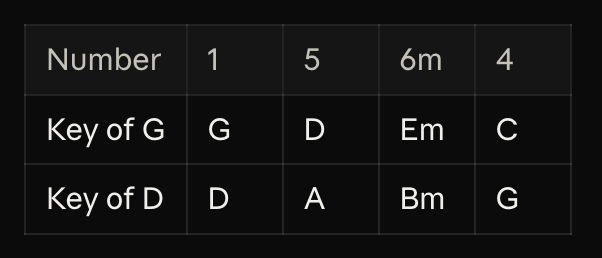
The Nashville Number System (NNS) writes chords as numbers instead of letter names. Each number stands for a step of the major scale of whatever key you're in. The 1 is home, the 4 and 5 are the other two big chords, and the 6 is usually the relative minor (written 6m or 6-).
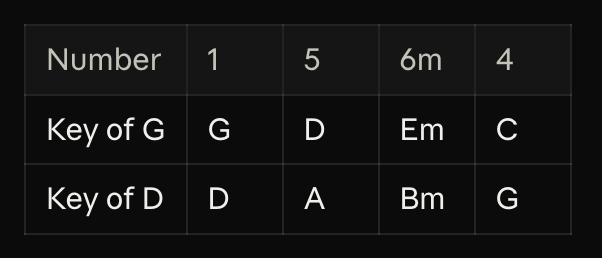
Here's the same progression in two keys.
The chart never changes, only the key does. That's the magic: once a song is written in numbers, you can play it in any key without rewriting a thing. The system grew up in Nashville recording studios in the late 1950s, where session players needed to chart a song quickly and adapt to whatever key the singer wanted.
Why it's worth learning
It broadens your understanding of music. Letter names tell you what to play. Numbers tell you why. When you start thinking in numbers, you notice that hundreds of songs share the same handful of progressions. You begin to hear where a song is going before it gets there, and learning new songs gets dramatically faster.
It makes transposing painless. The leader wants to drop the song a whole step? With a number chart, nobody needs a new chart. You just think in the new key and keep playing.
It gives the MD a simple, fast language. In rehearsal or in the middle of a set, the music director can call out "go to the 4" or hold up four fingers, and every player knows exactly where to go, whatever key you're in and whatever instrument they play. No scrambling, no confusion, no stopping the flow of worship.
Where to start
Read: Song Charting Made Easy by Jim Riley. This is the book most players point beginners to first. It's a short, 64-page play-along guide written by the drummer and bandleader for Rascal Flatts. It starts with the basic 1, 4 and 5 chords and builds step by step to minors, inversions and key changes. It also comes with 90+ audio examples and full-band tracks, so you can hear the numbers while you read them.
Practice: Number System Trainer (iPhone app). Reading about numbers is one thing; hearing them is another. This app trains your ear to recognize chords by number across three levels, and it opens with a quick five-step lesson on how the system works. It's built with worship and session players in mind. A few minutes a day and you'll start hearing "that's a 4 chord" without thinking about it.
So, should you learn it?
Yes. You don't need to master it overnight. Start with the 1, 4, 5 and 6m, chart one song you already know, and listen for those chords in everything you hear this week. It won't be long before numbers feel more natural than letters, and you'll be a stronger, more confident player on any team you serve with.